Postdoctoral Research Associate at the Institute of Astronomy, University of Cambridge
Exploring planetary system dynamics and giant impacts
About Me
I am a postdoctoral researcher at the
Institute of Astronomy, University of Cambridge.
I completed my Ph.D. at the
Tata Institute of Fundamental Research in Mumbai,
where I studied the dynamical evolution and stability of planetary systems, focusing on how instabilities and
planet–planet collisions shape their architectures. My current research explores the long-term consequences of
planetary collisions — in particular, how the debris they produce evolves, falls back onto planets, and drives
atmospheric erosion.
Research
Re-accretion of Giant Impact Debris
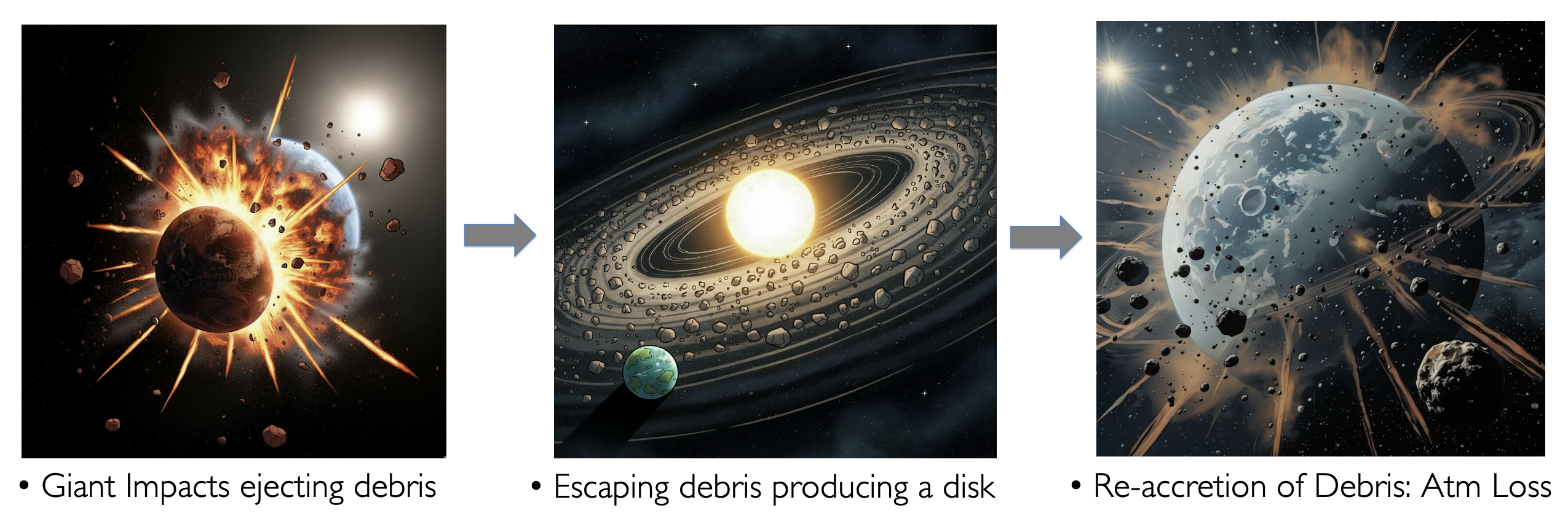
Growing young planets often smash into each other in giant impacts.
These impacts play a crucial role in sculpting the planets and their orbital architectures.
Computer simulations have advanced our understanding of these events, enabling estimations
of mass and atmospheric loss during the primary impacts. However, high computational costs
have restricted investigations to the immediate aftermath, limiting our understanding of
the longer-term consequences.
We investigate the long-term effects by following the collisional and dynamical evolution
of the debris ejected during the primary impacts. We found that a fraction of the debris
would be re-accreted back to the progenitor — ~0.001 MEarth over a wide range of
Earth-like planet properties, assuming ~1% of their mass is ejected as non-vaporised debris.
Over time, numerous secondary impacts can drive substantial atmospheric erosion from terrestrial planets.
For example, the impacts from the debris of the canonical Moon-forming impact, could have eroded Earth’s present atmosphere within tens of millions of years.
Our results highlight the crucial role secondary impacts from giant-impact ejecta could have
in driving the long-term atmospheric evolution of Earth-like planets, and demonstrate that giant
impacts can be significantly more effective at eroding such atmospheres than previously thought,
when re-accretion of debris is considered.
Ghosh, T., Wyatt, M. C., & Shorttle, O. (2025). Re-accretion of Giant Impact Ejecta Can Drive Significant Atmospheric Erosion on Terrestrial Planets • Monthly Notices of the Royal Astronomical Society, 544, 2120. • DOI • arXiv
Planetary Collisions
Dynamical instabilities in close-in tightly packed systems, similar to those found in abundance by Kepler, often lead to planet-planet collisions. The most common type of known exoplanets are "sub-Neptunes". In such planets, mass is concentrated in a dense core, but the volume is dominated by a low-density gaseous envelope. We use advanced computer simulations to explore what happens when two sub-Neptunes collide under different conditions. We found that, in most cases where the cores don’t directly hit each other, the planets don’t merge into a single larger one. Instead, both sub-Neptunes survive the encounter, often with significant atmosphere loss. When mergers do occur, the collision is extremely violent, leading to significant mass loss.
Ghosh, T., Chatterjee, S., & Lombardi, Jr., J. C. (2024). Outcomes of Sub-Neptune Collisions. The Astronomical Journal, 168, 238. DOI • arXiv
Dynamical Instabilities
NASA’s Kepler mission discovered many multiplanet systems with planets packed much closer together than those in our solar system. The mutual gravitational interactions in such tightly packed systems often make them unstable, leading to dynamical instabilities with planets being lost due to collisions and ejections, until the system eventually settles into a more stable configuration (as shown in the video). We use advanced computer simulations to investigate how those instabilities shape the final orbital arrangements of planetary systems. After accounting for detection biases, the post-instability systems from our computer models closely resemble the ones discovered by Kepler. This suggests that many of the compact exoplanet systems we observe today have undergone such instabilities in their past, which has significantly influenced their current orbital configurations.
Ghosh, T. & Chatterjee, S. (2023). Orbital Architectures of Kepler Multis From Dynamical Instabilities. Monthly Notices of the Royal Astronomical Society, 527, 79. DOI • arXiv
Planet-Planetesimal Scatterings
Newly born planets dynamically interact with countless leftover rocks and icy bodies that did not grow into or get accreted into a planet. This study investigates how the scattering of these smaller bodies can influence the orbits of planets, especially pairs of adjacent planets. Using extensive computer simulations, we found that these interactions often push planets slightly apart, sometimes breaking them out of orbital resonances (where their orbits line up in integer ratios like 2:1 or 3:2). Interestingly, if the planet pairs are narrow of the resonance like the ones shown in the video, these interactions cause them to jump the resonance and get deposited wide of the resonance. The results match the Kepler observation that many exoplanet pairs sit just outside of resonance. This suggests that leftover planetesimals played a significant role in shaping the orbital patterns we observe today.
Ghosh, T. & Chatterjee, S. (2023). Effects of Planetesimal Scattering: Explaining the Observed Offsets from Period Ratios 3:2 and 2:1. ApJ, 943, 8. DOI • arXiv
M.Sc. in Physics, University of Calcutta, Kolkata, India (2018)
B.Sc. in Physics (Honours), RKM Vivekananda Centenary College (WBSU), India (2016)
Research Interests
Exoplanets; Planet Formation; Long-term Evolution & Stability of Planetary Systems; Giant Impacts; Giant Impact Debris; Atmospheric Erosion from Giant Impacts and Debris; Debris Disks
Publications & Preprints
Ghosh, T., Wyatt, M. C., & Shorttle, O. (2025). Re-accretion of Giant Impact Ejecta Can Drive Significant Atmospheric Erosion on Terrestrial Planets. MNRAS, 544, 2120. DOI • arXiv
Ghosh, T., Chatterjee, S., & Lombardi, Jr., J. C. (2024). Outcomes of Sub-Neptune Collisions. The Astronomical Journal, 168, 238. DOI • arXiv
Ghosh, T. & Chatterjee, S. (2023). Orbital Architectures of Kepler Multis From Dynamical Instabilities. MNRAS, 527, 79. DOI • arXiv
Ghosh, T. & Chatterjee, S. (2023). Effects of Planetesimal Scattering: Explaining the Observed Offsets from Period Ratios 3:2 and 2:1. ApJ, 943, 8. DOI • arXiv
Gold Medalist for highest marks in B.Sc. (Hons.) (2016)
Service
Journal Referee for The Astronomical Journal
Organizer, LCLU Annual Science Day (2025)
Volunteer, Frontiers of Science, TIFR (2018-2023)
LOC Member, MODEST-20 Conference (2020)
Selected Talks
“Giant Impact Ejecta Driving Enhanced Atmospheric Loss,” Talk, Smashing It: How Impacts Forge Formation, Dynamics, and Climates of (Exo)Planets, University of Leeds, UK (June 2025)
“Orbital Architectures of Kepler Multis From Planet-Planet Scattering,” Contributed Talk, Strange New Worlds, IISER Pune, India (Aug 2023)
“Orbital Architectures of Kepler Multis From Planet-Planet Scattering,” Contributed Talk, APRIM, Koriyama, Japan (Aug 2023)
“Sculpting Planetary Systems via Planet-Planet Scattering & Collisions,” Invited Seminar, MPIA, Heidelberg, Germany (Jul 2023)
“Dynamical Instabilities and the Orbits of Kepler's Multis,” Contributed Talk, Complex Planetary Systems II, Kavli-IAU Symposium, Namur, Belgium (Jul 2023)
This is bold and this is strong. This is italic and this is emphasized.
This is superscript text and this is subscript text.
This is underlined and this is code: for (;;) { ... }. Finally, this is a link.
Heading Level 2
Heading Level 3
Heading Level 4
Heading Level 5
Heading Level 6
Blockquote
Fringilla nisl. Donec accumsan interdum nisi, quis tincidunt felis sagittis eget tempus euismod. Vestibulum ante ipsum primis in faucibus vestibulum. Blandit adipiscing eu felis iaculis volutpat ac adipiscing accumsan faucibus. Vestibulum ante ipsum primis in faucibus lorem ipsum dolor sit amet nullam adipiscing eu felis.
Preformatted
i = 0;

while (!deck.isInOrder()) {
    print 'Iteration ' + i;
    deck.shuffle();
    i++;
}

print 'It took ' + i + ' iterations to sort the deck.';